
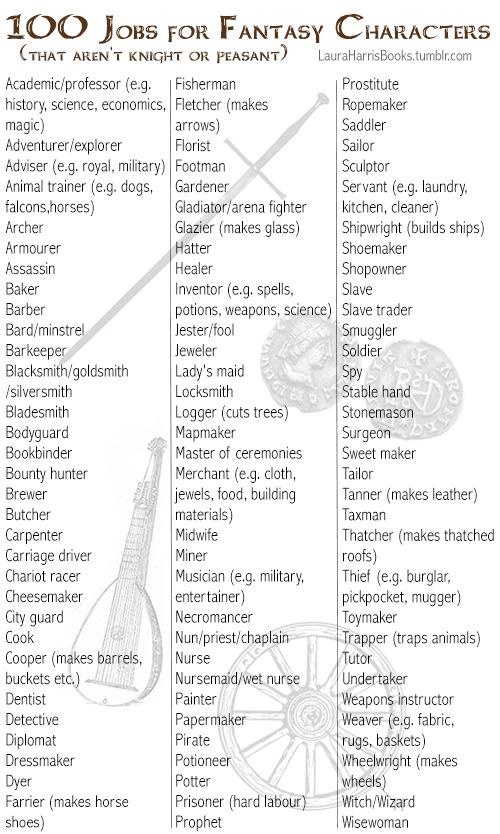
Beyond this, consider how these professions might vary depending on who the customers are – nobles, or lower class. Are they good at their job or just scraping by? Do they work with lots of other people or on their own? City or village?
For younger characters:
- Apprentice to any of the above
- Messenger/runner
- Page/squire
- Pickpocket
- Shop assistant
- Student
- Looks after younger siblings
(Images all from Wikimedia Commons)
Also consider:
Candlemaker
Ferryman
Factor (looks after business for an employer in another city)
Tiler
Cutler
Beekeeper
Apothecary
Interpreter
Furrier
Moneylender/Banker
Winemaker
Tinker (small trader who repairs stuff)
Nightsoil collector
Customs officerAlso a bonus for animal related professions:
Fowler (supplies game birds for eating)
Warrener (catches rabbits on your land for you to eat)
Ostler (looks after your horses)
Falconer (looks after your falcons)
Cocker (looks after your fighting cocks)I need more fantasy rpg in my life that isn’t d&d-style. I think it’s time for some Sword & Backpack.
100 Jobs for Fantasy Characters (that aren’t knight or peasant)
((long list, so it’s below the cut))
Yes, this is good and important
You wouldn’t think “sugar-baker”
(pastry-chef) gave much scope for adventure, but Switzerland had a great
reputation for skilled sugar-bakers so a a lot of medieval and Renaissance
sugar-bakers were Swiss.They were freelance, travelling from place
to place and being hired to make Impressive Stuff for a banquet here or a feast
there, in that Duke’s castle or that Prince’s mansion.They were also spies. There’s a famously
wrong line in the movie “The Third Man”:“You know what the fellow said – in Italy,
for thirty years under the Borgias, they had warfare, terror, murder and
bloodshed, but they produced Michelangelo, Leonardo da Vinci and the
Renaissance. In Switzerland, they had brotherly love, they had five hundred
years of democracy and peace – and what did that produce? The cuckoo clock.”Not only did Switzerland not produce the
cuckoo clock (which came from the Black Forest in Germany) but its principal export during the middle ages and Renaissance was mercenary soldiers,
the most feared in Europe. They were called “the Dirty Swiss” because at a time
when a standard tactic was to outbid and buy the contract of an opponent’s mercenaries, a
contingent of Swiss mercs stayed bought until their job was done.As for that job, a paraphrase of Kyle Reese’s
speech from “The Terminator” could go something like this:.“Listen, and understand. Those Swiss are out
there. They have a contract. They’ll keep to that contract, so they can’t be
bargained with and they can’t be reasoned with. They don’t feel pity, or
remorse, or fear. And so they don’t have to fight you again next week, next month,
next year, they’ll take no prisoners, and they absolutely will not stop, ever,
until you break and run or are all dead.”So where did the sugar-bakers come into
this? They moved around the members of society who might want to hire
mercenaries, so they were in a position to see rivalries and enmities develop
and send back the information that, say, Baron A was about to take a slap at Count
B over a land dispute, and would welcome two companies of
pikemen and one of arquebusiers at a reasonable rate for two months.They were also able to report back that Marquess
C, currently hiring a company of halberdiers, was throwing lavish parties to
impress the king but was behind on his fees and unlikely to get caught up, so
the expiry-through-non-payment clause of the halberdiers’ contract would come
into effect on the first day of June. Also that Sieur D, the Marquess’s rival, would
be more than happy to sign them up and might pay a large bonus if that signing-up happened while the mercs were still under Marquess C’s roof…None of these noble gentry would be happy
to know that the man making éclairs in their kitchen was reporting back their
financial and political secrets to a foreign power, but would be happy to learn what else their
sugar-baker knew and about whom they knew it. And when they asked, it wouldn’t start
with “Please…”The only
reason why the Swiss didn’t conquer large areas of Europe was a lack of unity
and trust. Outside Switzerland they were Swiss, but inside Switzerland their loyalty
was to their cantons – Zürich, Appenzell,
Uri, Bern, Basel etc. – and no fox leaves other foxes to mind their
henhouse while they’re away from home.Are these a few story seeds, perhaps? If so, you’re welcome…
This is useful! I say as I am reading it. But then…
Since when is “Slave” a fucking JOB!??!?
 Tess's Back Up